Muse Spark, Untangled
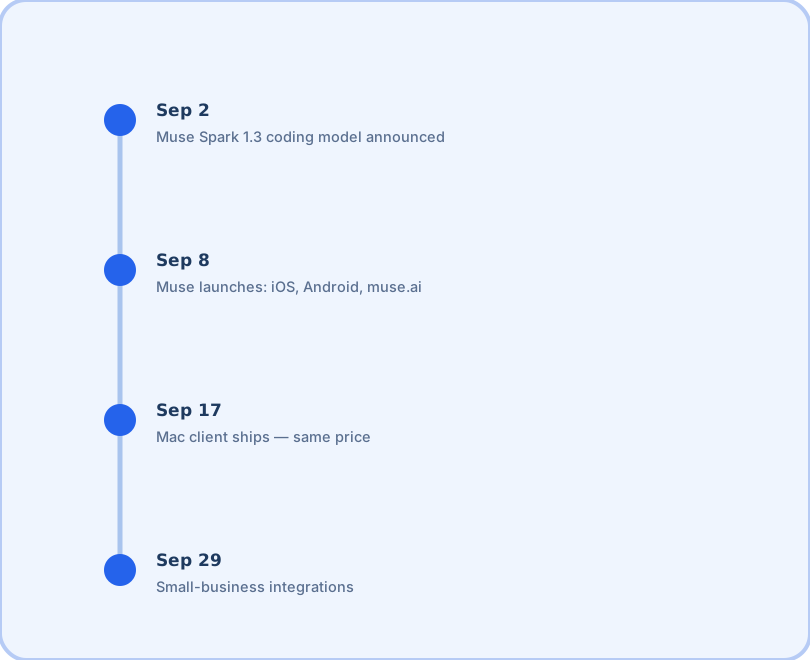
Two Muses shipped in one week and the naming stuck together. The short version: Muse Spark 1.3 is the model; Muse is the product. One writes and refactors code through an API; the other books your Thursday.
The family tree
Per launch reporting: Muse Spark 1.3 — described as Meta's most capable agentic coding model — was announced September 2, 2026, and became broadly available September 8 through Muse Code and Meta's Model API. The consumer Muse agent, launched the same day, runs on the latest generation of models from the same family (developed under Meta's chief AI officer Alexandr Wang). So when your agent plans your week, Spark's cousins are doing the thinking.
| Name | What it is | Who touches it |
|---|---|---|
| Muse | The consumer agent: errands across your connected services | Everyone — apps, web, Mac, WhatsApp |
| Muse Spark 1.3 | The agentic coding model (announced Sep 2, 2026) | Developers, via code and API |
| Muse Code | The developer surface for Spark's coding workflows | Developers |
| Model API | Programmatic access to Meta's model family | Developers building products |
What Spark is for
Spark targets long-running coding and agentic workflows — the multi-file, tool-using, hour-long jobs — not chat. If you are a developer, your touchpoints are Muse Code and the Model API; if you are an end user, you will never install Spark, and that is fine.
Why the naming matters to buyers
Two practical consequences. First, pricing: Muse subscriptions and Spark's developer access are separate budgets — upgrading Muse to Maximum does not buy API capacity. Second, expectations: reviews that blend "the agent" with "the coding model" blur the real question. Judge Muse as an errand-runner (our use cases and pricing pages), and Spark as a rival to other agentic coding models on developer terms.
The strategic read
Shipping a consumer agent and a developer model under one brand in one week is a statement: Meta wants Muse to mean "AI that does the work" everywhere — your errands and your codebase. For consumers that mostly means one thing: expect the agent to get more capable as the model family iterates, and expect the naming to keep colliding. We will keep this page updated as the two products' boundaries clarify. If you are evaluating Spark as a developer, benchmark it on the jobs it names — long, tool-using coding runs — rather than on chat benchmarks, which measure a different product entirely.
Frequently asked questions
Is Muse Spark part of my Muse subscription?
They are siblings, not one product: Muse is the consumer agent; Muse Spark 1.3 is the coding model aimed at developers, available through Muse Code and Meta's Model API. Your Muse tiers buy agent usage, not API access.
What does "agentic coding model" mean?
A model built to carry out long coding workflows — multi-file changes, tool use, extended runs — rather than answer single prompts. Spark 1.3 was announced September 2, 2026 and broadly available September 8.
Who is Spark for?
Developers building on Meta's models — via Muse Code or the Model API — rather than end users running errands in the Muse app.