Muse vs ChatGPT
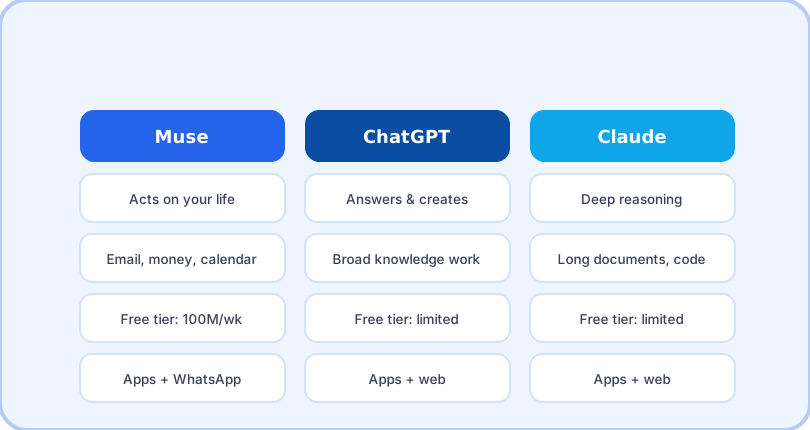
Muse and ChatGPT are both AI assistants from big labs — and then the resemblance ends. One is built to act on your life; the other to think with you. Knowing which week you are having picks the tool.
The core difference
ChatGPT's frame is conversation: you ask, it answers, drafts, codes, explains. Muse's frame is execution: you describe an outcome that lives in your email, calendar, shopping or bills, and it works the problem across those services until done. A chatbot drafts the "can everyone do Thursday?" message; an agent sends it after checking every calendar.
Side by side
| Dimension | Meta Muse | ChatGPT |
|---|---|---|
| Center of gravity | Errands across your connected services | Knowledge work: writing, analysis, coding |
| Connections | Email, calendar, payments, health, shopping, smart home | Broad but less personal — no native calendar/inbox agent |
| Free tier | ~100M tokens/week + card on file | Limited access to best models |
| Paid tiers | $20 / $100 per month (usage headroom) | $20 Plus and higher (features + limits) |
| Surfaces | iOS, Android, web, Mac, WhatsApp | iOS, Android, web, desktop apps |
| Launch maturity | Months old, fast-moving | Years old, mature ecosystem |
Where each one wins
Muse wins the week. Anything measured in "did it get done" — scheduling chased down, renewals audited, baskets compared — plays to an agent wired into your services. ChatGPT wins the page. Anything measured in "is this good" — an essay, a contract's summary, a tricky function — plays to a mature general model with a deep ecosystem.
Why keeping both is normal
They are not competing for the same minutes. The practical pattern many households land on: ChatGPT (or a similar general assistant) for thinking and making; Muse for the administrative life that surrounds the thinking. The four-dollar question to ask each tool weekly: what did I hand you that actually got finished? Muse's scoreboard is errands closed; ChatGPT's is pages produced — different sports, different standings.
And if you want the opposite pole — an agent oriented to your machine rather than your services, running open source with any model you like — that's a different animal again; our comparison of open-source agents like Hermes covers that route.
Frequently asked questions
Is Muse a replacement for ChatGPT?
Not really — they are shaped differently. ChatGPT is a general assistant for creating and answering; Muse is wired into your email, calendar and payments to execute errands. Heavy users legitimately keep both.
Which free tier is better?
Different currencies. Muse reports a 100-million-token weekly allowance for free users; ChatGPT gates its best models and features. For errands, Muse's free tier is unusually generous; for writing and coding help, ChatGPT's ecosystem is deeper.
Does ChatGPT also fill out forms for me?
ChatGPT has browser-style capabilities, but its center of gravity is conversation and creation — Muse's launch framing (connecting email, calendar, payments, health, shopping and smart home, then executing) is a different job.